
Busy is a Lie


TL;DR
Your team isn’t failing because they’re not working hard—it’s because activity is replacing outcomes.
Without clear ownership, defined results, and a visible scoreboard, execution breaks down and everything flows back to you. That’s how you become the bottleneck.
The fix isn’t more communication, coaching, or tools.
It’s installing a structure that enforces ownership, measures outcomes, and restores trust.
Execution scales when outcomes—not effort—drive performance.
Executive Summary
Execution failure rarely presents as inactivity. It presents as motion without measurable outcomes. You see visible effort and assume progress, which creates a false sense of performance. Without a system that ties ownership to outcomes, activity becomes a substitute for execution—and you become the bottleneck. Installing the Empowerment Operating System restores clarity, trust, and consistent delivery.
The Pattern You Notice
Across leadership teams, the pattern is consistent: high activity, low traction. Your team reports effort …meetings, updates, initiatives; yet outcomes remain inconsistent. The business feels busy, but execution lags. In response, you increase involvement, unintentionally reinforcing dependency and slowing execution.
The Misdiagnosis
This is often treated as a clarity or capability issue. You respond with more communication, more coaching, or new tools - - including AI. These actions increase activity, but they do not convert effort into outcomes because the system remains unchanged.
Your Reality as the Leader
Execution is driven by ownership, defined outcomes, and visible performance. When these elements are missing, your team defaults to activity. Over time, trust erodes, not because of capability, but because the system does not require results.
System Breakdown
Without the Empowerment Operating System, four failures appear:
ownership is implied instead of explicit
outcomes are loosely defined
performance is not visible
missed commitments carry no structural consequence
The result is predictable—execution slows, and you become the bottleneck.
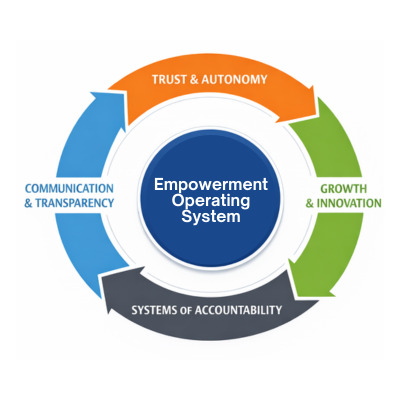
The Shift
The shift is structural. You move from managing activity to installing a system that enforces clarity, ownership, and measurable outcomes. This is where execution scales.
Implications
Most leaders recognize this pattern. Few correct it. Awareness does not change behavior.
Without a system, teams revert to activity quickly.
This is why the problem persists.
Not because you don’t see it.
Because nothing in the system prevents it.
What Fixes It
Execution improves when you install a repeatable structure that converts effort into outcomes. The sequence matters.
1. Define outcomes precisely
Tie outcomes to measurable business movement. Remove interpretation.
2. Assign single-point ownership
One outcome. One owner. No diffusion.
3. Install a visible scoreboard
Performance must be visible weekly. If it’s not visible, it’s not real.
4. Enforce commitment integrity
Missed commitments are reset immediately through structure—not emotion.
5. Remove yourself as the safety net
Execution scales when ownership stays with the team.

Practical Application
Pick one outcome this week.
Assign one owner.
Define the metric and deadline.
Track it visibly.
Review based on results only.
You will see the gap immediately.

