
The Bottleneck Exists Where the Empowerment Operating System Is Not Installed

TL;DR
Execution challenges are often attributed to capability gaps or lack of alignment. In practice, the more consistent issue is structural: organizations are operating without an installed Empowerment Operating System. Without it, Decision Ownership remains undefined, Trust Transfer does not occur, and Execution Speed declines. As a result, decisions default upward and leaders become the bottleneck. This pattern is predictable. It is the outcome of operating without a system that installs ownership.
Pattern
A consistent pattern emerges. Decisions are escalated rather than owned. Team members defer instead of committing. Work progresses, but outcomes lag. Leaders increase communication and alignment efforts, yet behavior does not change. Activity increases, but Execution Speed does not. The system continues to pull decisions back to the same point.
Misdiagnosis
In my experience, most leaders respond by increasing control. They add oversight, introduce more structure, and implement tools—including AI—to improve output. The assumption is that the team requires more direction or discipline. These actions fail to resolve the issue because they do not address the absence of an installed system.
Reality
The issue is not capability. It is operating without an installed Empowerment Operating System. Without it, Decision Ownership is unclear. When Decision Ownership is unclear, Trust Transfer does not occur. Without Trust Transfer, escalation becomes the safest behavior. Over time, this creates dependency, slows Execution Speed, and concentrates decision-making at the top.
System Breakdown
In the absence of an Empowerment Operating System™, execution cannot scale. Trust remains centralized instead of transferred. Communication provides context but not ownership. Growth is constrained because capable people are not required to decide. Accountability becomes diffused because ownership is not defined. The result is consistent: decisions return upward, creating a bottleneck.

The Shift
The shift is not behavioral. It is structural. Leaders must install an Empowerment Operating System that defines Decision Ownership at every level. This enables Trust Transfer and restores Execution Speed. The goal is not more involvement, but better system design.
The Implications
Without installing an Empowerment Operating System, Execution Speed declines, leadership capacity is constrained, and high-performing team members disengage. The organization becomes dependent on centralized decision-making, limiting scale and resilience.
Most leaders can see this pattern. Very few correct it. Not because they lack awareness, but because awareness does not install a system.
Execution: Installing the Empowerment Operating System
The constraint is not understanding. It is installation.
Most leaders recognize the bottleneck. They experience it daily. But in live moments, they revert to speed. Without a system installed, Decision Ownership does not shift and Trust Transfer does not occur.
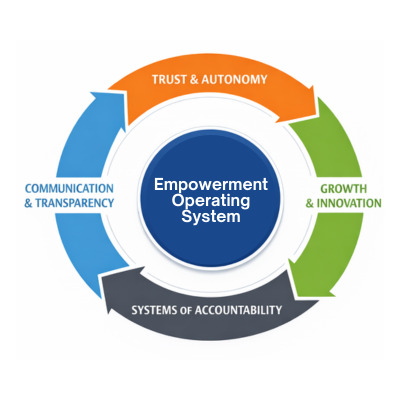
This is how you begin installing the Empowerment Operating System.
1. Decision Ownership Audit:
Review the last 10 decisions that came to you. For each:
Where should ownership have existed?
What was unclear at the point of escalation?
What prevented Trust Transfer?
This exposes where the system is not installed.
2. Define Decision Ownership:
Decisions fully owned by your team
Decisions requiring alignment
Decisions retained by you
Without this step, Trust Transfer cannot occur.
3. Install the Response Pattern:
“What’s your recommendation?”
“What outcome are you driving?”
“Make the call.”
This is how Decision Ownership becomes real.
4. Stabilize Priorities:
Set 3–5 weekly priorities. Hold them.
Stability enables Trust Transfer. Trust Transfer increases Execution Speed.
5. Reinforce Ownership Publicly:
Acknowledge it first. Refine second.
This is how the Empowerment Operating System becomes visible and repeatable.
These steps are simple. Installing them consistently is not. Systems don’t install themselves.
If this is showing up in your team, I’m happy to take a look with you.


