
The Hidden Cost of Controlled Communication in Leadership


TL;DR
You’re not dealing with a communication problem. You’re dealing with controlled communication.
When you filter context, soften decisions, or delay clarity, you create a clarity gap.
That gap turns you into the bottleneck, and your team slows down—not from lack of capability, but lack of context.
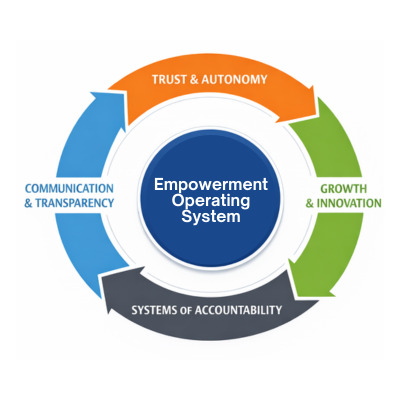
Inside the Empowerment Operating System™, this is a failure in Communication &
Transparency.
The fix is simple—and uncomfortable: Stop managing the message. Start delivering full context.
Clarity scales execution. Control creates the bottleneck.
If your team can’t move without you, you already know where to look.
Executive Summary
Execution breakdowns are rarely caused by a lack of effort. It is far more likely that the breakdown is caused by your controlled communication. When you filter context, delay clarity, or manage messaging too tightly, you create a clarity gap that slows execution and positions you as the leadership bottleneck. This is not a communication issue. It is a failure inside the Empowerment Operating System™—specifically, a breakdown in Communication & Transparency.
Pattern
Here are some consistent patterns that may sound familiar to you.
You believe you are communicating clearly, yet your team experiences confusion and misalignment.
Decisions are shared without full context.
Messaging shifts across functions.
Your team relies on you for interpretation instead of acting with confidence. Execution slows and dependency increases.
Misdiagnosis
Most leaders respond by increasing communication volume.
More meetings.
More updates.
More tools, often supported by AI.
Activity increases, but clarity does not. The assumption is that more communication will fix the issue. It won’t. More communication will actually do damage.
Reality
The real issue is controlled communication. Information is filtered, softened, or delayed to manage perception or reduce risk. In doing so, you remove the context required for effective decision-making. What remains is partial direction—enough to start, but not enough to execute.
System Breakdown
Inside the Empowerment Operating System™, this failure cascades. Trust weakens because information is incomplete. Decision quality declines because context is missing. Accountability erodes because expectations are unclear. Execution slows because your team cannot move without you. This is a direct failure in Communication & Transparency.
Shift
The shift is direct. Replace control with clarity. Move from managing the message to delivering full context. The standard becomes simple: your team has enough information to act without returning to you. This requires alignment at the leadership level before communication is delivered.

Implications
Clarity scales execution. → Control creates the bottleneck.
Most leaders understand this conceptually. Very few execute it consistently.
Because clarity feels risky in the moment. And control feels efficient.
That’s why this doesn’t get fixed.
Awareness isn’t the issue. Behavior is.

