
The Leadership Bottleneck Most Executives Misdiagnose

When execution slows, accountability weakens, and outcomes become inconsistent, most leaders assume they have a communication problem, a talent problem, or a culture problem.
In reality, many organizations are carrying trust debt.
Trust debt accumulates when leadership behavior and leadership messaging stop aligning. Every missed commitment, unexplained decision, and inconsistent standard creates a small withdrawal from the trust account.
Most leaders do not notice the impact until execution slows and the organization becomes increasingly dependent on leadership intervention.
The result is predictable: slower decisions, reduced ownership, weaker accountability, and the emergence of a leadership bottleneck.
The Moving Target Pattern
In my experience, most organizations rarely experience a sudden breakdown. The decline is gradual.
Leadership communicates yet another version of “their” vision. Then the team realigns, and priorities shift. Commitments move. Standards become inconsistent. Decisions are made with less transparency. Over time, the team comes to distrust what leadership says.
The shift changes behavior throughout the organization.
People become cautious. Initiative declines. Escalations increase. Decisions move upward. The organization loses velocity.
The Misdiagnosis
In most cases, organizations respond by increasing communication, implementing new systems, investing in leadership development, or deploying new technology.
Many leaders side-step these issues by looking toward AI as a solution for alignment and communication.
These investments may improve efficiency, but they do not repair trust.
Broken trust is not a communication issue.
Broken trust is an execution issue.
Until trust is restored, every improvement effort operates below its potential.
The Reality
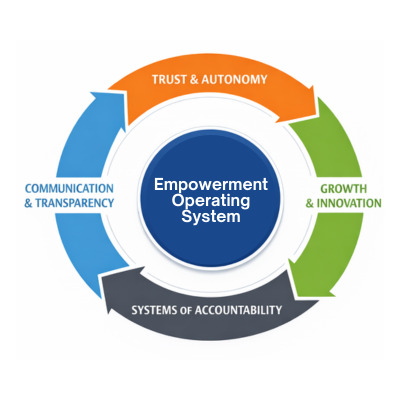
Within the Empowerment Operating System™, trust is the foundation that supports Communication and Transparency, Growth and Innovation, and Systems of Accountability.
When trust declines, the entire system begins producing friction instead of outcomes.
People hesitate.
Decisions slow.
Innovation decreases.
Accountability becomes difficult.
The organization becomes increasingly dependent on leadership involvement.
What appears to be a performance problem is often a trust problem.
What appears to be a culture problem is often a leadership credibility problem.
The System Breakdown Process
Trust creates confidence.
Confidence accelerates decisions.
Faster decisions improve execution.
Improved execution creates outcomes.
When trust is damaged, this sequence reverses.
Leaders become bottlenecks.
Teams become reactive.
Organizations lose momentum.
Shift
The most effective leaders stop asking:
"How do I improve culture?"
They start asking themselves:
"Where have I created trust debt?"
That question moves attention from symptoms to causes.
It shifts focus from programs to behavior.
It shifts focus from awareness to execution.
Implications
Trust remains one of the few competitive advantages that cannot be automated, delegated, or purchased.
AI can accelerate information.
AI cannot create trust.
Trust still comes from leadership behavior.
Organizations that protect trust create velocity.
Organizations that neglect trust create drag.
Most leaders know where trust has been damaged.
Very few have a repeatable process for rebuilding it.
That is where organizations get stuck.
Awareness is not the challenge.
Execution is.
The difference between organizations that restore trust and organizations that continue accumulating trust debt is disciplined behavior.
The following framework is the same sequence I use when coaching leaders through trust recovery efforts.
Step 1: Identify Trust Debt
Review every significant commitment made during the previous twelve months.
Strategic commitments.
Team commitments.
Customer commitments.
Personal leadership commitments.
Trust debt accumulates when commitments disappear without acknowledgement.
Create a written inventory.
Most leaders underestimate the amount of trust debt they carry.
Step 2: Audit Decision Transparency
Review the last ten major decisions.
For each decision ask:
Was the desired outcome explained?
Were tradeoffs communicated?
Was the reasoning visible?
Did people understand why the decision was made?
Trust grows when decisions become understandable.
Step 3: Install Leadership Accountability
Trust recovery begins when leadership accountability becomes visible.
When mistakes occur:
Acknowledge them quickly.
Explain the lesson.
State the correction.
Demonstrate changed behavior.
Nothing rebuilds credibility faster.
Step 4: Measure Trust Through Behavior
Ignore surveys initially.
Watch for:
Faster decisions
Increased ownership
More candid conversations
Fewer escalations
Improved execution
Trust reveals itself through behavior long before it appears in survey data.
Practical Application
For the next 30 days, run every significant decision through a single filter:
"Will this increase trust or create trust debt?"
That question alone will improve decision quality, execution velocity, and organizational outcomes.
After four decades of leading teams, rebuilding organizations, and coaching executives, I have learned that trust drives execution and execution drives outcomes.
Every organization eventually reflects the behavior its leaders consistently demonstrate.
If you are wrestling with this challenge, I am always happy to offer a second set of eyes.
Sometimes the trust gaps closest to us are the hardest ones to see.
The mission of the 1000 Leaders Empowered Movement is simple:
Help leaders build teams that trust, execute, and achieve extraordinary outcomes.

